Guide · 2026-05-06
How Mille-Feuille Conquered Paris
A four-century walk through the city that turned a folded-butter trick into a thousand-leaf monument.
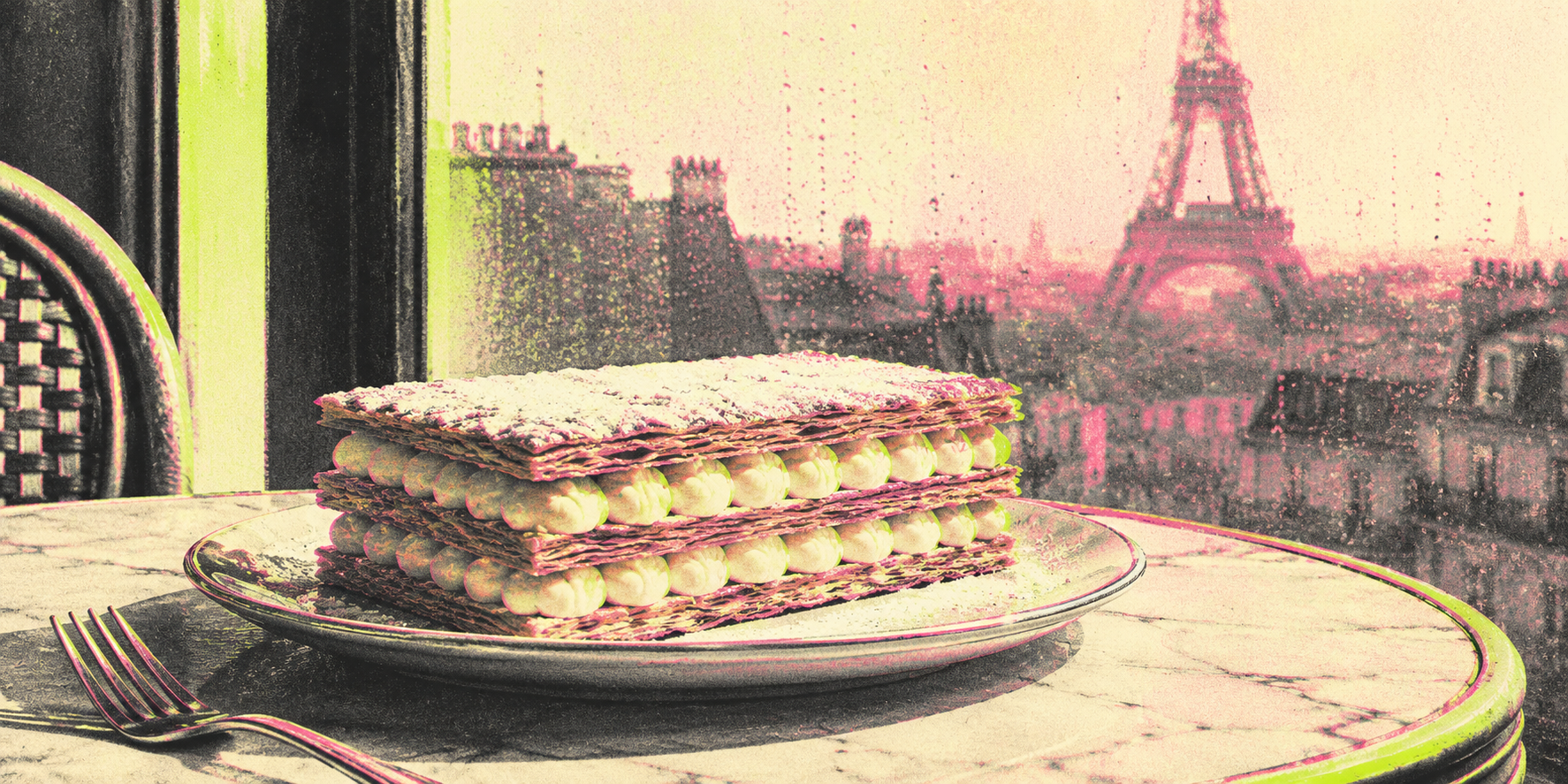
A trick before it was a pastry
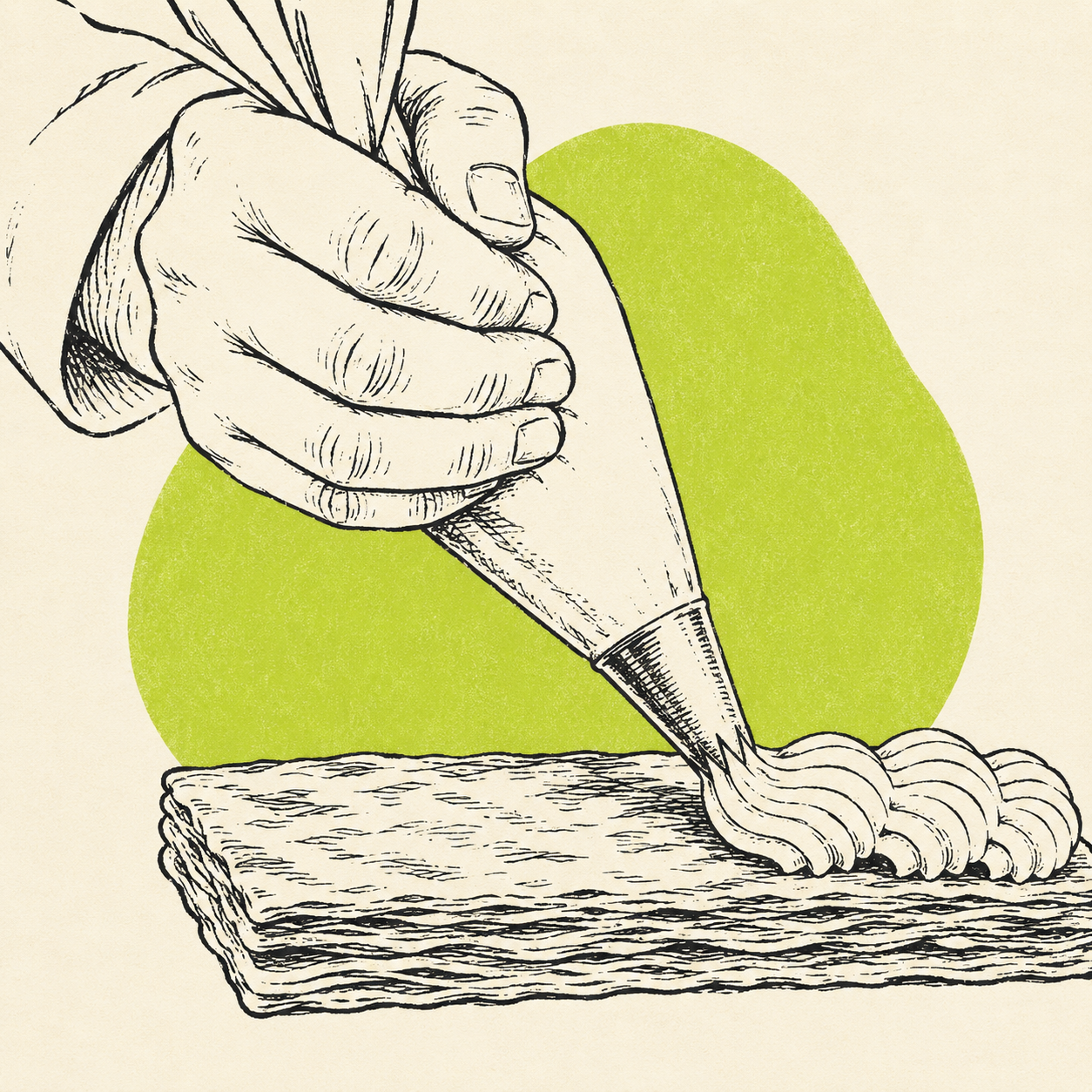
The first time mille-feuille is described in print, it is not yet called mille-feuille and it is not yet a Parisian object. La Varenne’s Le Cuisinier François (1651) records a pastry of butter laminated into dough across several turns, served as a savory base for game and reductions. The technique — folding a slab of butter into a sheet of dough so that, in the oven, water flashes to steam between paper-thin sheets and pries them apart — is older than its dessert vocation. La Varenne treats it as a structural trick, not a confection. A century would pass before anyone in Paris saw the leaves themselves as the point.
By the time the eighteenth century closed, Parisian patissiers had begun to file the trick under sweets. The leaves were brushed with sugar, baked dark, and stacked with a custard or a jam. The name mille-feuille — “a thousand leaves” — appears in shop ledgers and cookbooks in the 1730s and 1740s, but the dessert remains uneven, inconsistent, more an idea than a standard.
image pending
Carême’s geometry
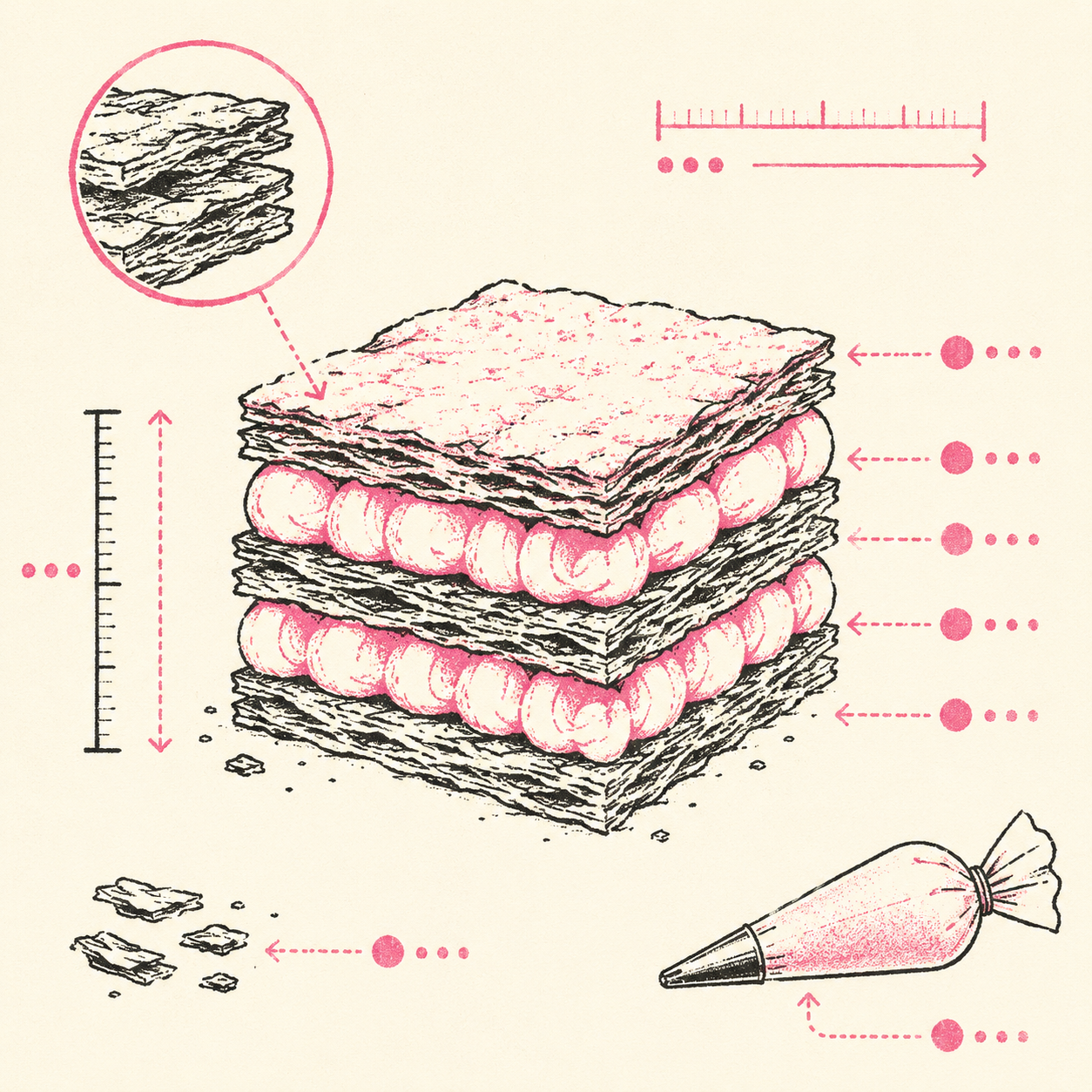
What turned the dessert into a monument was Marie-Antoine Carême. Carême — pastry chef to Talleyrand, then to the Prince Regent, then to the Rothschilds — believed pastry was architecture, and architecture answered to mathematics. In Le Pâtissier Royal Parisien (1815) he laid out the lamination of mille-feuille not as a feel, but as a count: six turns of three folds, yielding 729 layers of dough alternating with 728 layers of butter. The number is sometimes rounded up to 1000 in homage to the name; Carême’s count is the truer figure, and the figure most modern Parisian patisseries still target.
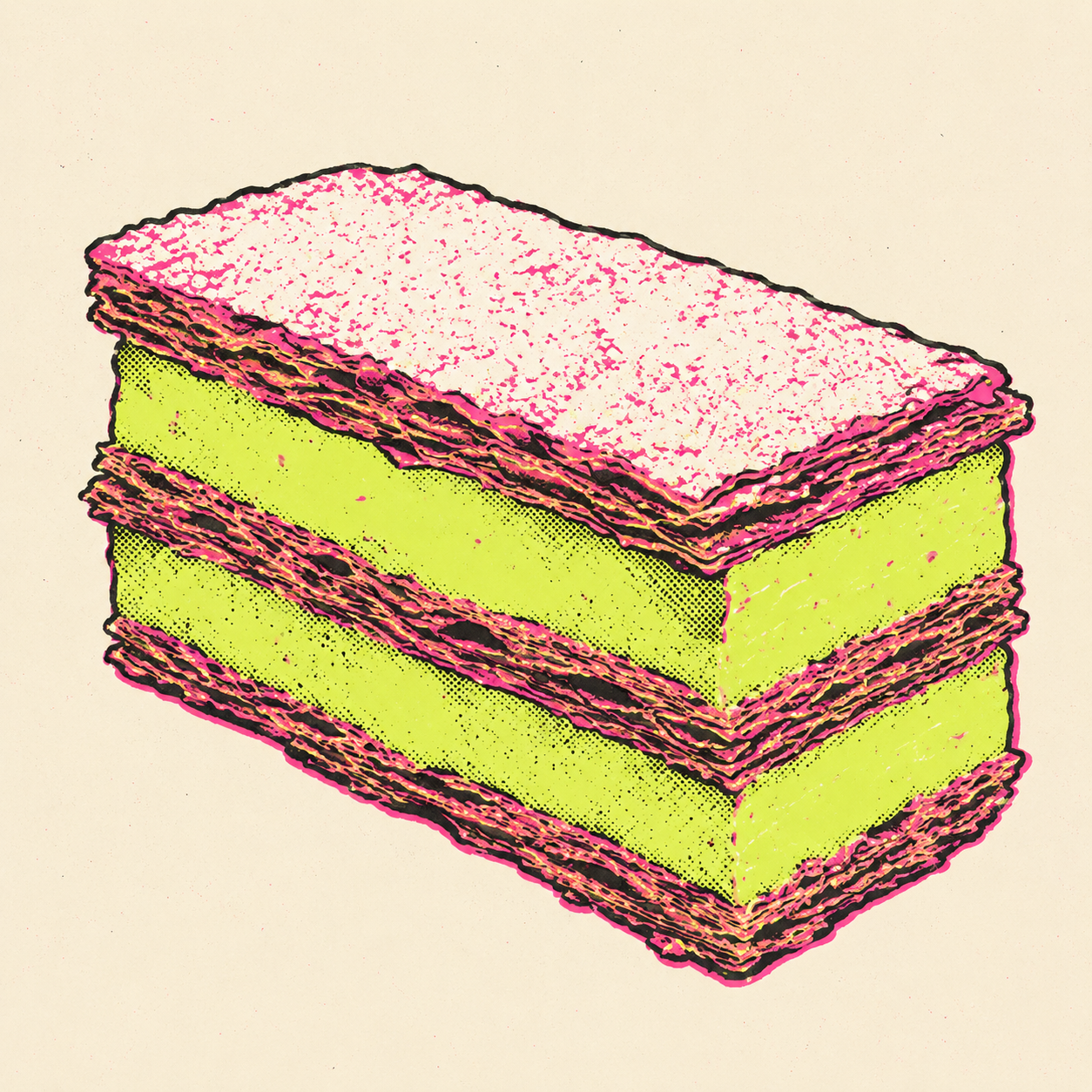
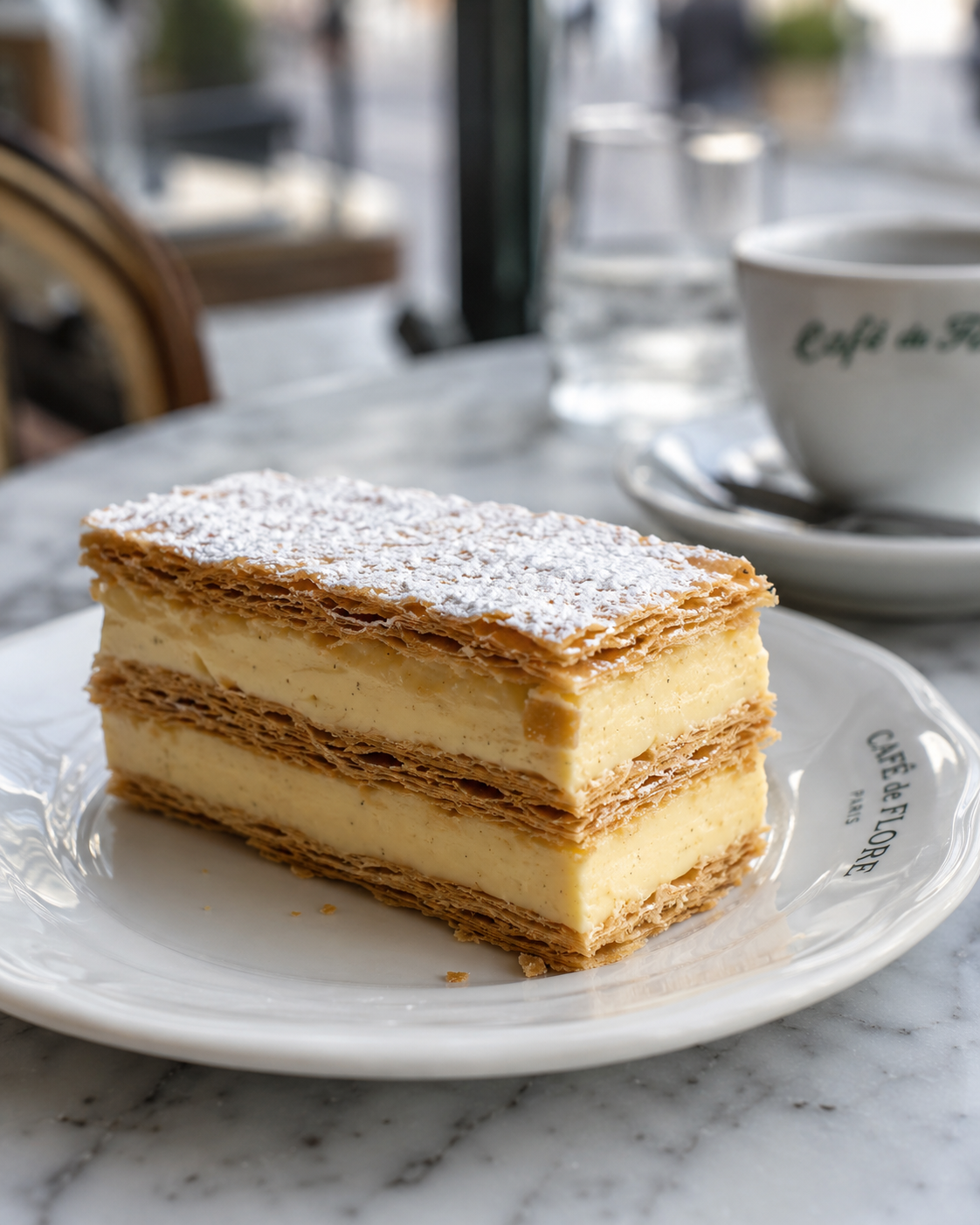
Carême also fixed the assembly. Three sheets of puff. Two layers of pastry cream — vanilla, lightened with a touch of butter, never with whipped cream, which he considered a cheat. A glaze of fondant on top, marbled with chocolate in tight feathered lines, drawn through with the back of a knife. This is the silhouette anyone who has stepped into a Paris patisserie in the last two centuries will recognize. Carême did not invent the elements. He nailed down the proportions.
image pending
The twentieth century: glass, light, modern
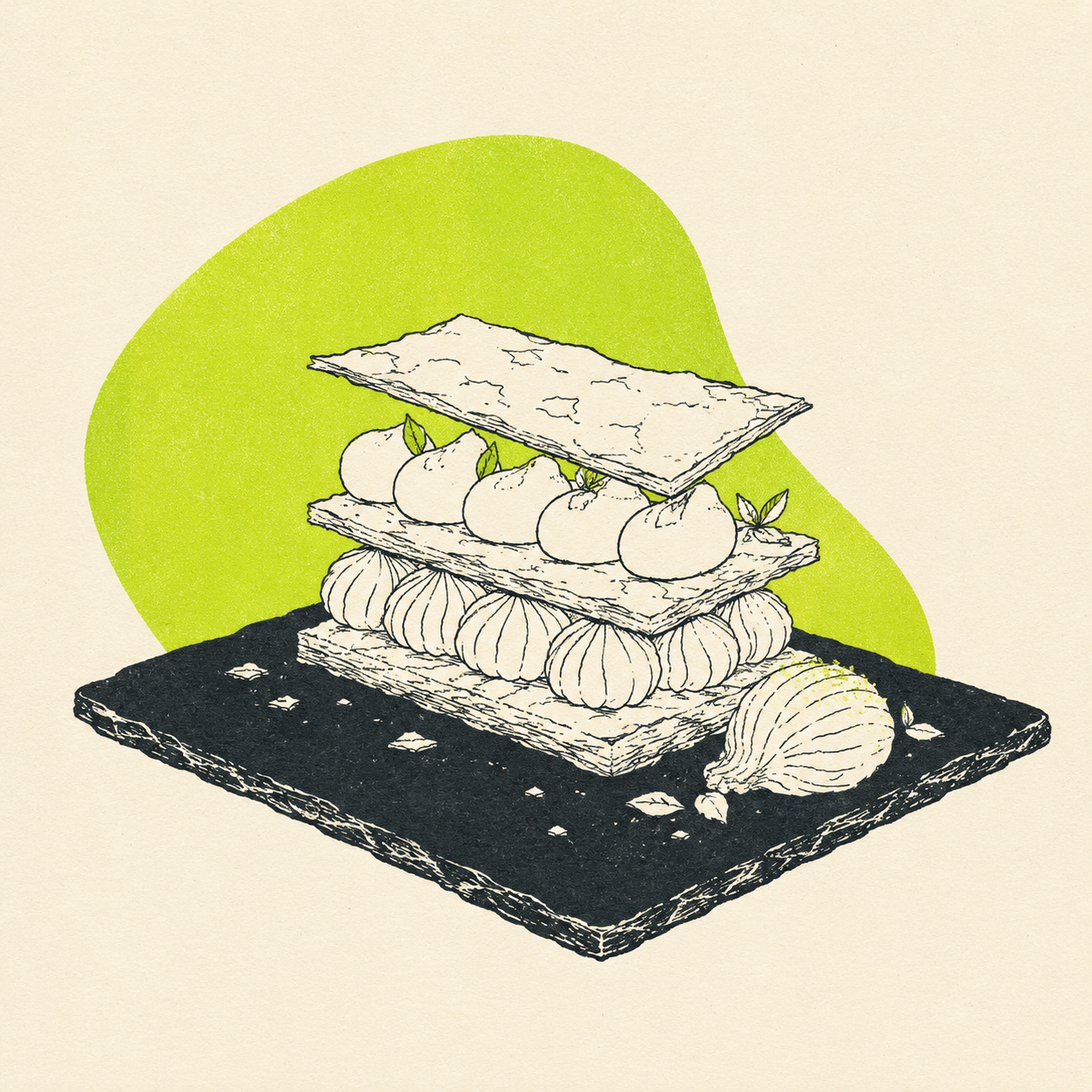
For most of the nineteenth century the mille-feuille of Carême’s geometry sat in shop windows essentially unchanged. The disruption was twentieth-century. Refrigerated cases let pastry creams stay looser and more delicate. Stainless steel let bakers laminate at lower, more consistent temperatures, which sharpened the layer separation. By the 1980s a generation of Parisian chefs — Pierre Hermé during his Fauchon years, then Philippe Conticini, then later François Payard from his New York exile — were rebuilding the dessert from the inside out.
Hermé inverted it: caramelized puff on top, soft cream below, sometimes with the tiers turned vertical so the layers stood upright on the plate. Conticini pushed the cream toward a Madagascar vanilla so concentrated the rest of the dessert had to recede to accommodate it. Payard, writing for an American market, simplified the glaze and emphasized the snap of the puff over the depth of the cream. None of them abandoned Carême’s count. They argued, instead, about what the layers were for.
image pending
Tokyo’s naporeon
The dessert traveled. The most consequential journey was to Japan, where, beginning in the 1920s and accelerating after the war, French patisserie became a fixture of department-store food halls. Mille-feuille arrived under a transliterated name — mirufiiyu — but a parallel name surfaced in casual usage: ナポレオン, naporeon. The naming is a mild misattribution: Napoleon never had a documented connection to the dessert, and the French themselves do not call it that. The Japanese name probably traveled by way of an early-twentieth-century cookbook from Russia or central Europe, where Napoleon-tort — a related but distinct layered cake — was already common.
What matters is that Japan kept the geometry and refined the surface. Tokyo mille-feuille tends toward a thinner, drier puff and a less sweet cream, and the chocolate marbling is often executed with a precision that even Paris finds startling. The cross-pollination has gone both ways: a number of Tokyo-trained patissiers now run shops in the Marais, and several of Paris’s most celebrated mille-feuilles in the last decade carry obvious traces of a Japanese hand.
image pending
Paris now
A walk through the right arrondissements today turns up at least four schools of mille-feuille within a few metro stops of each other. The classicists at Stohrer (the city’s oldest patisserie, founded 1730) hold the Carême silhouette like a charter. Cédric Grolet, a few blocks away, builds a vertical cube of caramelized puff and Madagascar vanilla cream that abandons the glaze entirely. Yann Couvreur runs a version with whipped praline; Jacques Genin keeps a rotating seasonal cream. Each insists, plausibly, that theirs is the truest reading of the form.
What unites them — and what makes mille-feuille a Parisian object rather than a French one — is the willingness to argue this much, this publicly, about a dessert. Other cities make the pastry. Paris makes the discourse around it.
References
- La Varenne, François Pierre. Le Cuisinier François. Paris, 1651.
- Carême, Marie-Antoine. Le Pâtissier Royal Parisien. Paris, 1815.
- Hermé, Pierre. La Pâtisserie de Pierre Hermé. Montagud Editores, 2000.
- Payard, François. Simply Sensational Desserts. Broadway Books, 1999.
- Toussaint-Samat, Maguelonne. A History of Food, trans. Anthea Bell. Wiley-Blackwell, 2009.